
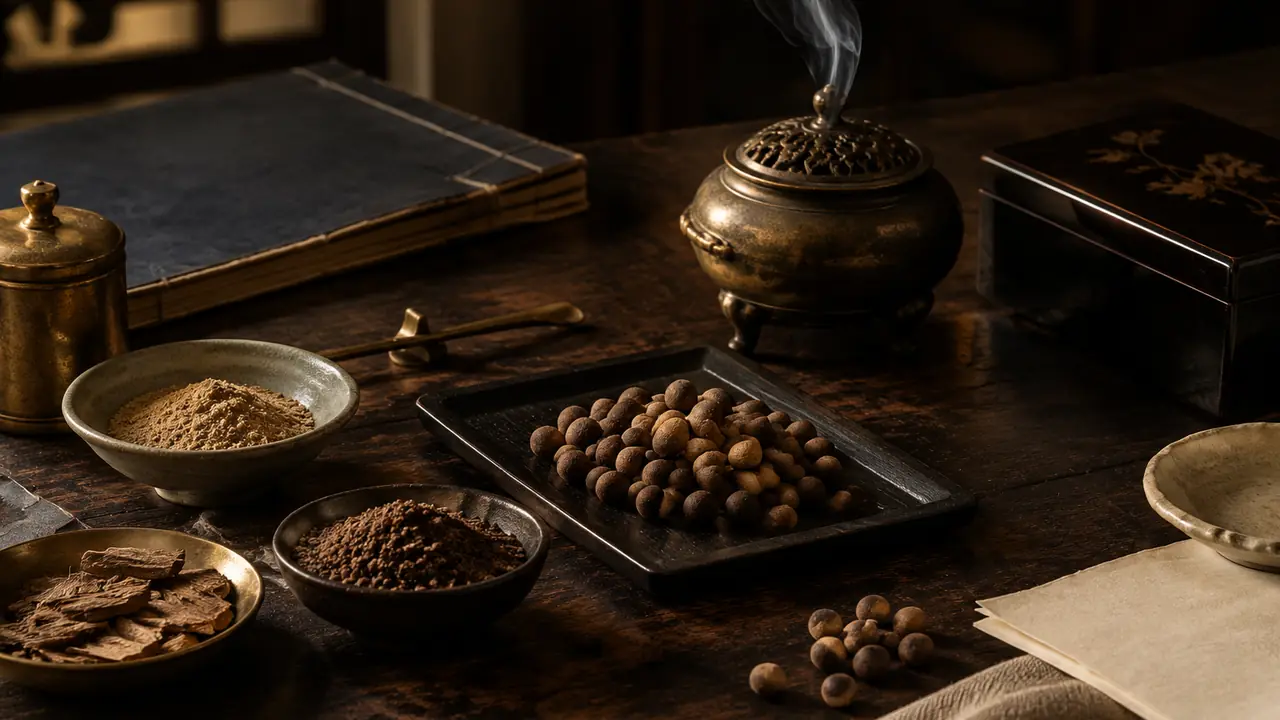
A shared starting point
Incense culture in East Asia travelled with trade and with religion. Aromatic woods and resins reached China first, and knowledge of compounding and burning moved from China to Japan in the early centuries of contact, much of it alongside Buddhist practice. Japan then developed its own forms, adapting what it received to its own taste and institutions. The result is two related traditions that look similar at the level of materials, since both prize agarwood and sandalwood, and differ at the level of how incense is used and discussed.
Kodo in outline
Kodo, often translated as the way of incense, is a formal practice of appreciating incense. A central idea is listening to incense: the participant holds a small vessel or breathes in the scent of heated material and attends to it with care. Incense games, in which participants identify or compare scents, are part of the tradition, and the whole is organized with a defined etiquette and a set of tools and schools. Japanese practice also includes kneaded incense, in which powders are blended with honey and other ingredients into small pellets and left to mature, which parallels the Chinese pastille. The emphasis is on the act of appreciation and its form.
Hexiang in outline
Hexiang, the Chinese blended incense tradition, puts more weight on the composition. Its written record is a record of formulas: Chen Shi Xiang Pu, Hong Chu's Xiang Pu and the Ming compendium Xiang Sheng are formularies and compilations that list ingredients, weights and preparation. Practice ranged from the study and the bedchamber to gifts and carried sachets, as described in incense in Tang and Song daily life, with less codified etiquette and more variety of use. The emphasis is on the blend and what it is made from.
A side-by-side view
| Point | Japanese kodo | Chinese hexiang |
|---|---|---|
| Emphasis | Formal appreciation, listening to incense | Composition of blends from many materials |
| Written core | School traditions, etiquette and tools | Formularies such as Chen Shi Xiang Pu and Xiang Sheng |
| Typical forms | Heated chips of wood, kneaded pellets, sticks | Powders, pills, sticks, sachets, beads |
| Wearable form | Scent bags and sachets | Sachets, scented pieces, modern incense beads |
| Main woods | Agarwood, sandalwood | Agarwood, sandalwood |
| Setting | Structured sessions | Study, home, gatherings, gifts |
Where incense beads sit
Incense beads are a Chinese format. They come from the logic of hexiang, with several powdered materials bound with a plant binder and honey, rolled by hand and aged. They are worn rather than heated or listened to in a formal session. Describing them as kodo beads would be inaccurate and would confuse customers who know the Japanese practice. A better description is Chinese blended incense in wearable form. Japanese customers and retailers can still appreciate the product, and a note such as a Chinese blended incense bead, related in ancestry to the Japanese tradition of kneaded incense, is accurate and respectful.
The shared ground is real, and a brand that carries both Japanese and Chinese incense products should keep the two clearly separate in naming and description. Names, packaging and cards should reflect the actual origin and tradition of each product.
Differences a buyer can feel
Customers who have used both traditions often describe a difference of mood in the scent. Japanese incense is commonly described as restrained, clean and quiet, with a lot of attention to the character of a single fine wood. Chinese blended incense is more often described as layered, sweet or warm, with herbs, fruit and honey in the mix. These are generalizations, and many products in both traditions break the pattern, but they are a useful guide when a customer asks for a scent direction. For an incense bead, the layered side is natural: the bead is a blend, rolled with honey and a plant binder, and it changes as it ages. A restrained version is still possible, with sandalwood as the chief material, little or no sweet element and a lower share of herbs.
Retail and display
A store that carries both traditions can help customers by grouping products clearly. A shelf card for each tradition, with two or three sentences of plain background, avoids confusion and invites browsing. Bracelets and strands sit well beside Chinese tea and lifestyle goods; burning products and tools may sit with other incense items. Staff should be able to say, in one sentence, what separates the two, and that sentence should match the table above. Where a retailer is unsure, the desk can supply short copy for cards and inserts for both the scent direction and the tradition, to be adjusted by the retailer.
Practical guidance for product writers
- Use the right term. Hexiang for Chinese blended incense, kodo for the Japanese practice. Do not use them as synonyms.
- Do not borrow etiquette. Beads are not used in kodo sessions; do not present a bracelet as a kodo item.
- Name no third-party brands. Describe the tradition, not particular makers.
- Respect shared materials. Both traditions value agarwood and sandalwood, so the same sourcing and legal points apply; see the agarwood guide and sandalwood guide.
- Keep claims to scent and tradition. No health or mood claims in either tradition.
When a Japanese-style product is requested
Some buyers want a scent in the Japanese taste, lighter and more restrained, or a product in a Japanese format such as a scent bag. That is a design brief, not a change of tradition. The desk can pass the brief to a partner workshop and propose a formula direction, for example a lighter sandalwood-forward blend with fewer sweet notes, and the product is then described as made in China to a customer-specified Japanese-influenced style. Do not label it as an authentic Japanese product. Sample rounds follow the normal pattern for custom blended incense, with reference timelines on MOQ and lead time, confirmed in writing for each program.
Send a short brief on the quote form that states the style you want, the format, the bead size and the market. To follow the way old formulas are being revived, read the modern revival of ancient incense formulas.