
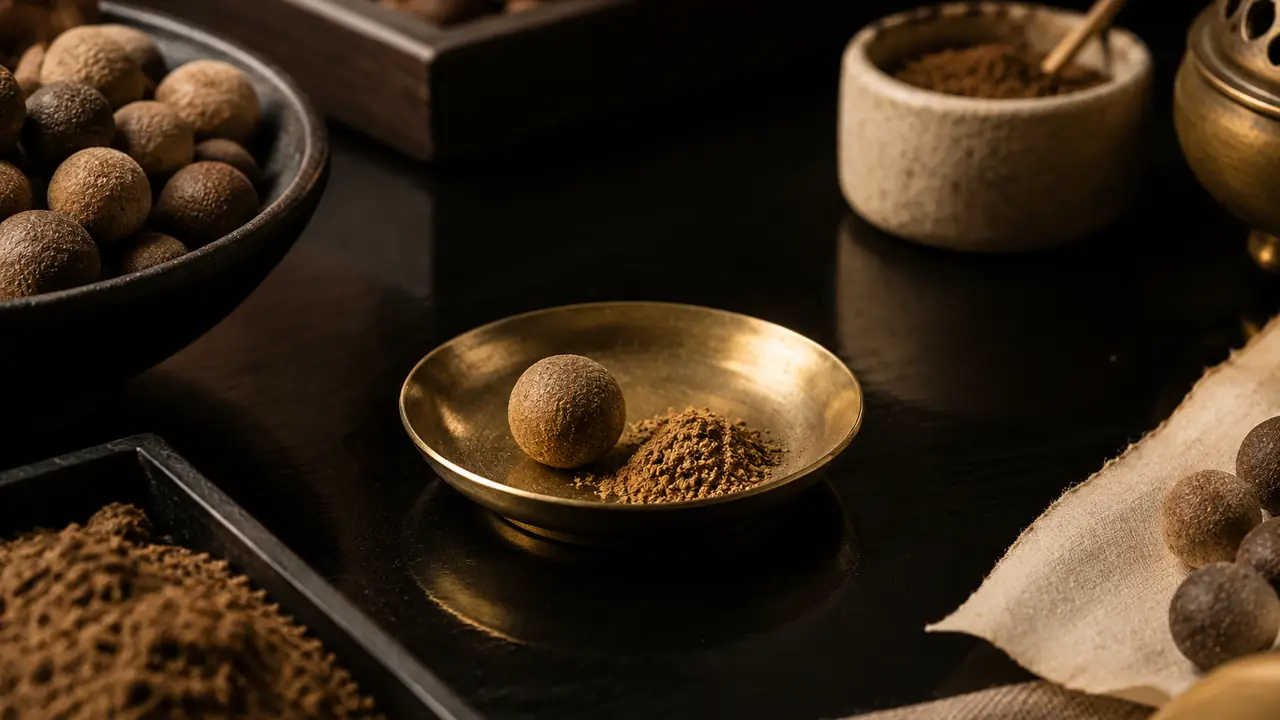
Blending as a design idea
Hexiang is usually translated as blended or composed incense. Instead of burning one material on its own, such as a piece of agarwood or a stick of sandalwood, a maker chooses several and combines them so the whole is more rounded than any part. The materials are woods, resins, herbs, spices, flowers and sometimes fruit or honey. Each is prepared separately - dried, steamed, roasted or ground - and then weighed into a formula.
Think of it as a perfumer's logic applied to botanical powder. A wood supplies the body, a resin the depth, a sweet element the softness and a sharp spice the lift. A binder holds the mixture together. The craft lies in proportion and in preparation, since the same ingredients in different ratios give very different results.
Written sources buyers will hear cited
Blended incense has a long written record in China. The sources are useful for buyers because they explain the names workshops attach to formulas and because they are used in marketing, sometimes loosely.
| Source | Period | Why it matters |
|---|---|---|
| Tang dynasty notes on incense | Tang | Early records of compounded incense in daily life |
| Chen Shi Xiang Pu | Song | A formulary of recipes, including the goose pear formula |
| Xiang Sheng | Ming | A compendium of incense materials and methods |
These books record formulas as ingredient lists with weights in the units of their time and with preparation instructions. A modern workshop reading them has to interpret ingredients that are no longer used or available, and convert traditional weights into grams. Where a brand claims a formula comes from a classical text, ask which text, which recipe, and what was changed in reconstruction. The goose pear formula is a good example; its history is covered in ancient incense formulas and goose pear incense beads.
The anatomy of a formula
Hexiang formulas tend to follow a familiar structure, even when the ingredients differ.
- The chief material. The main aromatic, often sandalwood or agarwood, sets the character and makes up the largest share of the powder.
- The supporting materials. Resins, herbs and spices that add depth or lift. They are used in small amounts.
- The harmonizing material. Something that softens the blend: honey, a fruit, a flower. In the pear formula the fruit steaming does this job.
- The binder. In beads, nanmu bark powder, often about a quarter of the powder weight, with honey as plasticizer. The binder has to be scentless or complementary so it does not take over. See the nanmu binder guide.
Written as a sheet, the formula for a standard sandalwood bead might read as a short list of percentages by weight. The honest version of that sheet is a document a buyer can approve and a workshop can repeat.
Preparation is half the recipe
A formula sheet lists what goes in, but in hexiang the treatment of each ingredient is as important as its name. Woods are dried and milled to a fine, even powder; resins may be roasted or steeped; herbs are cleaned and sometimes steamed. Fruit and flower elements are usually reduced to a juice or water that wets the dough. Even the order of mixing matters, because a dry blend is combined first and the liquid is added slowly until the dough reaches the right feel in the hand.
After mixing, the dough rests, is rolled, dried and aged, and during that time the scents of the separate ingredients begin to merge. This is why a freshly mixed batch smells rough and a bead aged in a sealed jar smells round. Buyers who evaluate a sample too soon after rolling may reject a blend that would have been fine a few weeks later, so sample plans should include a re-smell step after aging. The full sequence is in the making process guide.
From burning to wearing
Traditional hexiang was meant to be burned on a charcoal bed or in a censer, or carried in a sachet. Compounded pellets and incense beads brought the same blends into wearable form. The mixing logic carries over unchanged. What changes is the physics: a burned blend releases everything in minutes, while a bead releases slowly through warmth and friction, so formulas for wearing are tuned for steady, close-to-skin scent rather than for strong smoke. The chemistry of release is explained in how incense beads release scent.
This matters when a brand asks a workshop to reproduce a classical recipe as a bead. Some ingredients burn well but smell harsh when worn, and some are too oily to hold a bead shape. The workshop will often adjust, and that adjustment should be disclosed rather than hidden behind a historical label.
Hexiang compared with single-material scent
| Approach | Example | Character |
|---|---|---|
| Single material | Pure sandalwood or agarwood bead | Clear, simple, easy to describe |
| Blended (hexiang) | Sandalwood with agarwood, herbs or fruit | Layered, changes as it ages, harder to copy |
| Fragrance oil on wood | Scented wood bead | Strong at first, short-lived |
The blended route is more work to specify, but it gives brands something that is difficult for others to copy, since a formula is an asset. That is the commercial logic behind custom hexiang programs: the brand owns the proportions, the workshop owns the preparation, and the desk coordinates the sample rounds between them. See custom blended incense for the process.
What buyers should ask
- Ask for the formula as a list of ingredients with percentages by weight, not a poetic description.
- Ask which ingredients come from a classical source and which are the workshop's own.
- Ask whether any fragrance oil or industrial adhesive is used; the standard specification uses none.
- Ask for origin and documents for sandalwood and agarwood lots, including CITES for agarwood.
- Ask for a retained reference bead from the approved sample for later lot comparison.
Hexiang is a vocabulary, not a statement of quality. The term tells you how a scent was composed, not how well. A buyer who asks the five questions above will quickly see which workshops understand the craft and which only use the name. Send the first brief through the quote form, and the desk will shortlist partner workshops with a sample plan; reference timelines for custom formulas are listed on MOQ and lead time, confirmed in writing for each program.