
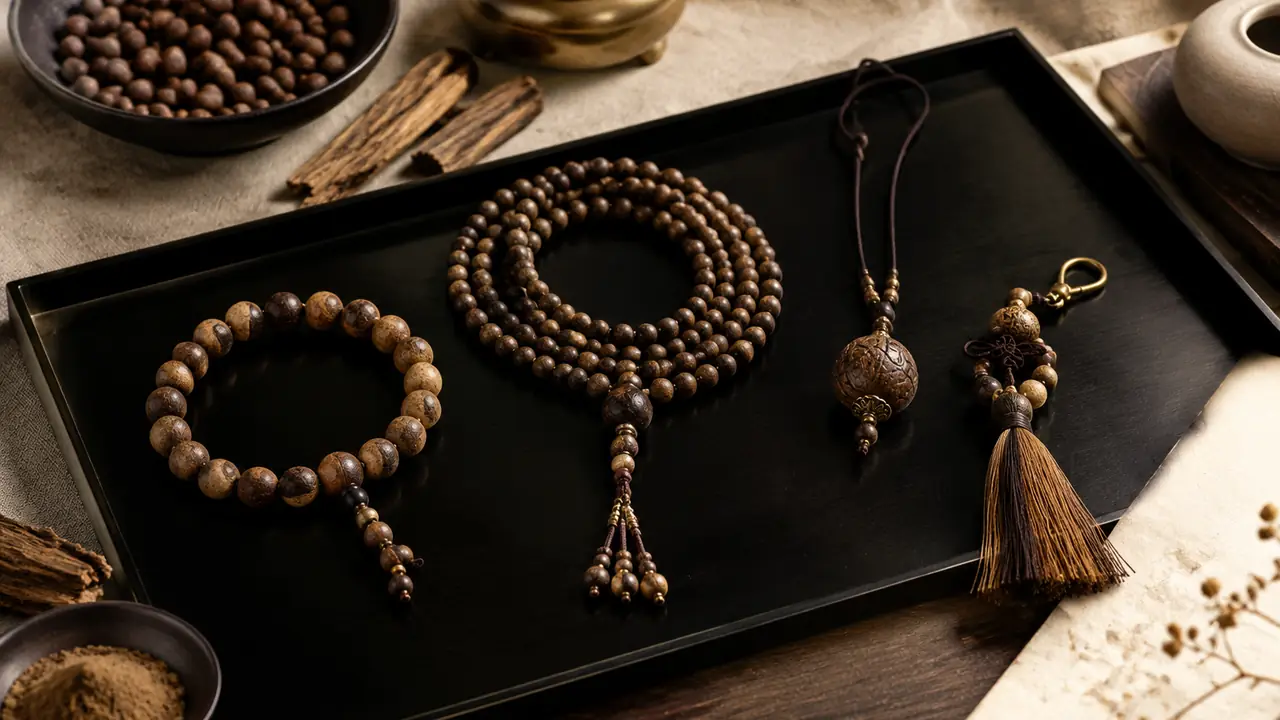
The source recipe
The formula is recorded in the Song dynasty formulary Chen Shi Xiang Pu and discussed again in the Ming compendium Xiang Sheng. In the version most often quoted, it calls for one liang of agarwood powder, one qian of sandalwood powder and ten goose pears, steamed three times. The pears are pressed for juice, the powders are soaked in it, and the mixture is steamed and dried in a repeated sequence until the fruit has been absorbed into the wood. Tradition links the recipe to Li Yu, the last ruler of the Southern Tang, who is said to have used it in his chambers. That attribution is a tradition, not a documented fact, and responsible copy says so.
The history, with its variants, is told in the goose pear incense history and the broader formulary context in ancient incense formulas.
From recipe to wearable bead
Classical recipes were written for burning, not wearing, and they leave many questions open: how big is a pear, how long is each steaming, how fine is the powder. A modern workshop answers them through trial. The reconstruction commonly follows this sequence.
- Mill agarwood and sandalwood to a fine powder and sieve it.
- Press goose pears or a close substitute such as Ya pears for juice; filter it.
- Soak the powders in the juice, then steam. Repeat three times, drying between cycles.
- Dry the treated powder in the shade, then mix with nanmu bark powder and a little honey into a dough.
- Rest the dough for about 24 hours, roll by weight, pierce, then shade-dry for 5-10 days.
- Polish, then age the beads sealed so the fruit and wood notes blend.
The steps from resting onward are the same as for any bead and are described in the making process. What is special is the first half: the repeated steaming is the reason the line takes longer to produce than stock bracelets.
What changes in a modern version
| Element | Classical record | Typical modern bead |
|---|---|---|
| Agarwood | One liang | Powder from cultivated Aquilaria, CITES documents per lot |
| Sandalwood | One qian | Santalum album powder, origin stated per lot |
| Fruit | Ten goose pears | Goose pear or pear juice, quantity set by the workshop |
| Process | Steamed three times | Three steam-and-dry cycles, then bead dough |
| Form | Burned in a censer | Wearable bead, bound with nanmu powder and honey |
Two points deserve honesty in copy. First, the modern bead is a reconstruction: the source weights are traditional units, and the workshop adapts the ratio to make a bead that holds together and smells good on skin. Second, the binder and honey are additions needed for a bead form that the original recipe did not include. A brand can say inspired by, or reconstructed from, the recipe; it should not claim an identical copy of a thousand-year-old formula.
What it smells like
The scent is sweet, rounded and fruity at first, over a warm woody base. As the beads age, the sweetness settles and the agarwood comes forward. Many users describe it as softer and more approachable than a pure agarwood bead, which makes it a good middle step in a range between sandalwood and agarwood. Do not promise a specific pear note; the juice is absorbed into the wood and the result reads as a gentle fruit sweetness rather than a recognizable fruit.
Specifications to write down
- Formula. Percentages of agarwood, sandalwood, pear-treated powder, binder and honey on the formula sheet.
- Fruit. Which pear is used and whether the juice is fresh or concentrated.
- Steaming cycles. The number of steam-and-dry cycles; the classical record says three.
- Size and count. 8 mm typically 18-22 beads; 10 mm typically 17-19.
- Documents. CITES for the agarwood component; ingredient declaration for the rest.
- Declaration. No synthetic fragrance oil and no industrial glue, confirmed in writing.
Sampling and approval
A reconstruction needs more sampling than a stock line, and it is worth planning for it. The first sample round shows whether the dough holds and how the fruit-treated powder behaves; it usually needs a second round to adjust the sweetness and the binder ratio. After the beads are aged, smell them again, because the fruit note settles and the first impression of a fresh batch is not the final one. Ask the workshop to retain a sealed reference bead from the approved sample so later lots can be compared against it.
It also helps to set the tolerance for appearance. Pear-treated powder gives a slightly warmer, browner tone than plain sandalwood, and the tone varies a little with each steaming batch. Agree a color range on the sample sheet instead of asking for exact match, and ask for a photograph of the approved strand under daylight to attach to the order.
Finally, decide how the story will be told before artwork is printed. A short card with the recipe source, written in neutral terms, adds value at little cost, but card text that changes after print means reprinting. Share the draft with the desk so claims about origin, ritual and scent are checked against the formula sheet and against the no-health-claims rule before they go to press.
Lead time and minimums
Because of the steaming and the aging, goose pear beads fall into the longer lead-time bracket. Typical reference ranges for custom or classical formulas are about 15-25 days for a sample and about 40-60 days for production, with manual rolling and drying as the bottleneck. Minimums for a custom formula typically start around 500 pieces and include the sample rounds. These are reference ranges, confirmed in writing for each program, and the full table is on MOQ and lead time.
Who buys this line
Temple and retreat shops like the line for its traditional pedigree and clean ingredient list; fragrance and lifestyle brands like it for the story and the unusual scent; gift programs like it because the narrative fits a card. If your customers care about the story, include a short note on the pack that explains the recipe source in neutral terms, and keep it factual. If you want a variation, such as a different fruit or a different wood ratio, ask the desk to run it as a custom formula through custom blended incense.
Send your size, count and quantity through the quote form for a formula sheet and a sample plan.