
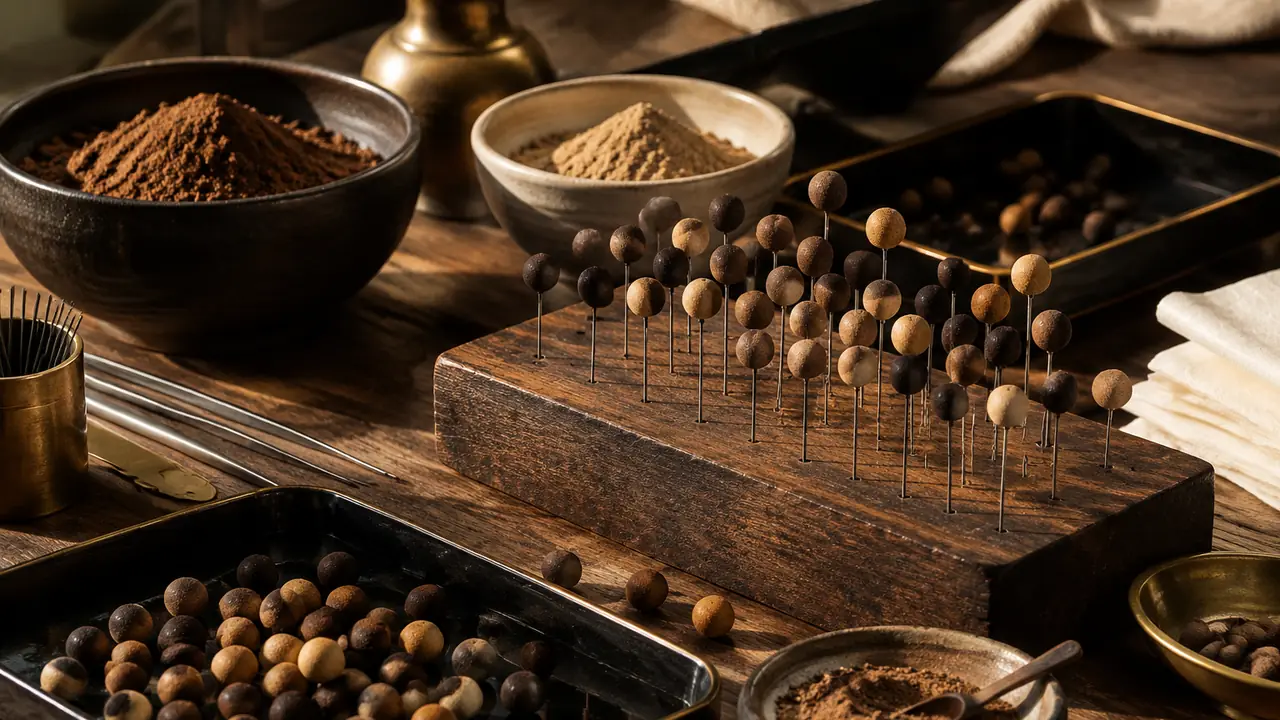
From dough to tablet
An incense tablet starts the same way as a bead: aromatic powder, nanmu bark binder and a little honey and water kneaded into dough and rested for about 24 hours. The difference comes at the shaping stage. Instead of being cut by weight, rolled and pierced, the dough is pressed into a carved mold or cut from a rolled sheet. The stages that follow, slow shade drying, finishing and aging, are the same in principle as those in how incense beads are made. The format appears in the catalogue as the incense tablet pendant.
Tablets are popular with fragrance brands and gift programs because the flat face carries a design. Where a bead can carry only color and a few accent marks, a tablet can carry a logo, a flower, a character or a landscape in low relief, and the piece hangs from a cord or tassel on a bag, a car mirror or a neck cord.
Typical dimensions
| Parameter | Typical range | Notes |
|---|---|---|
| Face size | About 30-50 mm | Larger pieces warp more and need longer drying |
| Thickness | About 3-6 mm | Thinner pieces dry faster but are more fragile |
| Relief or engraving | Low relief, engraved lines | Depth is limited by the dough |
| Hanging hole | One pierced hole, often near the top edge | Positioned for balance and strength |
| Cord | Cord, tassel or chain | Chosen with the design |
These are typical ranges for planning and not fixed limits; the actual dimensions for a program are agreed with the workshop and confirmed in writing.
The mold and the pressing
The mold is the center of the process. Tablet molds are carved in wood, resin or metal, and they hold the outline and the pattern. A worker dusts or lightly prepares the mold to ease release, presses a portion of dough into it, fills the corners with the thumb, trims the back flat and gently turns the piece out. A small pin makes the hanging hole. Press molds are described alongside the other tools in incense bead molds and tools.
The dough should be rested and slightly firmer than for rolling, since a soft dough smears detail and a hard one cracks at the edges. Pressure is firm and even. Too little leaves air pockets and weak corners, and too much squeezes dough out of the edge. This is where hand skill enters again, because a pressing worker feels how the dough fills a given pattern.
Relief, engraving and logos
Two kinds of surface design are common. Raised relief gives a pattern that stands up from the face, and engraving, an incised line pressed or cut into the surface, gives a quieter look that suits a brand mark. Both are subject to the character of the dough.
- Line weight. Very fine lines blur or close up as the piece shrinks. Lines with some width and depth stay legible.
- Undercuts. Shapes that overhang the mold wall do not release; designs should be simple in section.
- Small text. Letters below a certain height fill with dough. A brand name works best in a clean sans or bold serif at a generous size.
- Contrast. A natural dough surface is matte and tonal, so shadow, not color, makes the design visible. Leaf or a light wash can add contrast; see gold leaf and silver leaf.
An artwork brief with clean line art, the finished face size and a note about whether the design is raised or engraved lets the workshop propose a mold and a proof.
Drying without warping
Flat pieces dry differently from spheres. They lose moisture from both faces and the edges, and they curl if one side dries faster. Workshops lay tablets on flat, lightly porous boards in the shade, turn them at intervals and, for larger pieces, weigh them down very lightly toward the end. The drying range is similar to that for beads: roughly 5 to 10 days at about 25 C and 60% humidity, with thicker and larger pieces nearer the upper end. The reasons are explained in shade drying incense beads.
The common defects are edge cracks, warping and surface blooms. Edge cracks point to a dry dough or fast drying. Warping points to uneven airflow. A bloom or spot means the piece was sealed before it was completely dry. Weight stability across repeated checks is the practical sign that a tablet is ready for finishing.
Finishing and stringing
Dry tablets are sanded lightly at the edges, wiped clean and sometimes aged in sealed jars, like beads. They are then strung with silk cord, cotton cord or a metal chain and finished with a knot, a tassel or a bead. A tablet should hang flat and balanced, and the hole should be positioned so the face is upright. Packaging is part of the program; see packaging and gift boxes.
- Send artwork, finished size and thickness range.
- Approve a mold proof or first pressed piece.
- Approve a dried, finished sample with cord.
- Confirm quantity, packaging and delivery against the reference ranges.
Choosing between bead and tablet
Beads and tablets answer different needs, and many programs use both. A bead strand wins on wearability and scent exposure: it sits against the skin and warms evenly. A tablet wins on identity: it carries a mark that a customer recognizes at a glance, and it suits hanging uses such as a car mirror, a bag or a gift card. A brand with a strong logo often launches with a tablet as the hero piece and a plain bead bracelet as the entry product, both from the same formula so the scent is shared across the range. Pairing the two in one box is a simple gift idea, explained on the bracelet and sachet set page.
A short note on scent: because a tablet is flat and thin, it often smells quickly at first and then settles. Keep it sealed in its pouch until sale, and remind customers that hot cars and direct sun are not good places for any incense piece. Heat and light fade the scent and can warp a flat piece.
Minimums and timing
A custom mold adds a step before the first sample, and branded tablets sit in the private label tier, where typical reference minimums are about 300 to 1,000 pieces per design. Timing includes mold making, a sample round and the slow drying, so planning from the first drawing to delivery takes weeks, not days. The reference ranges are on MOQ and lead time and are confirmed in writing for each program. To start, send a brief through the quote form.