
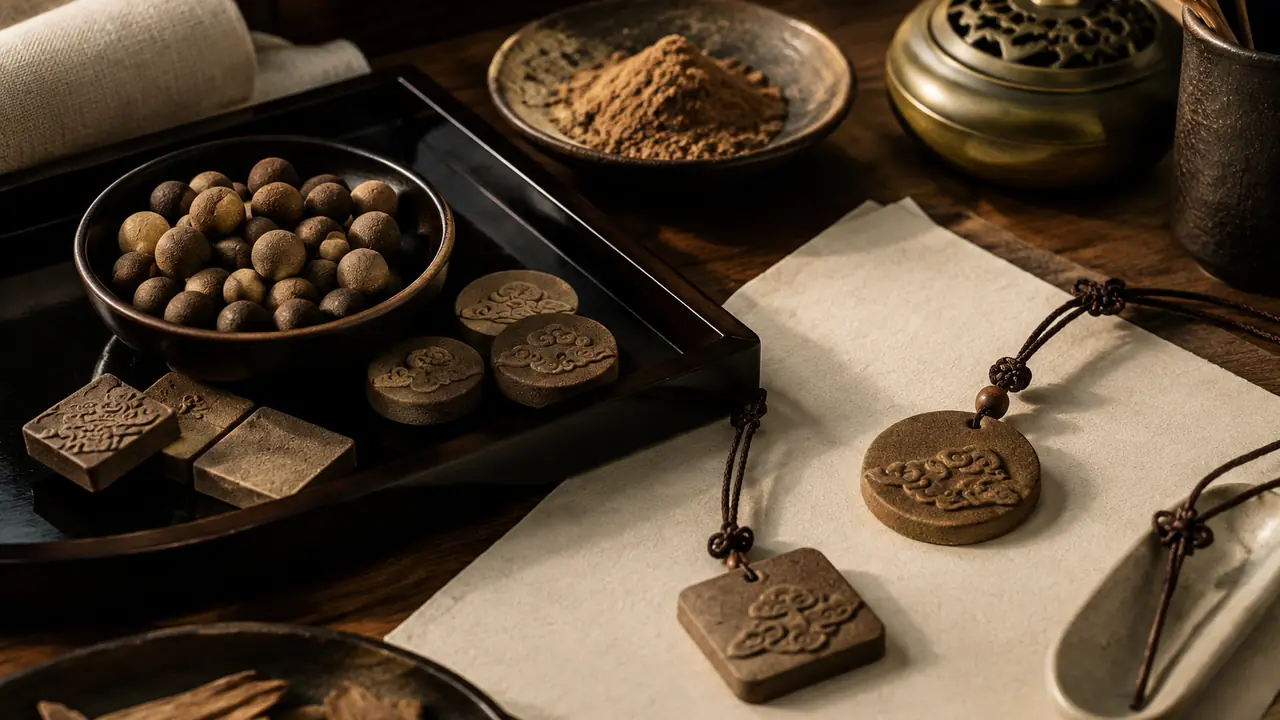
What an incense tablet pendant is
An incense tablet pendant is a small plaque made from the same dough as an incense bead. Sandalwood and agarwood powders are mixed with nanmu bark powder, a natural binder, and a little honey and water until the dough is smooth, rested, then pressed into a mold. After pressing, the tablet is dried slowly in shade, trimmed, polished at the edges and pierced or fitted with a loop for the cord. Nothing is burned. The tablet is worn, hung or carried, and the scent comes from the wood itself.
Compared with a bead, the tablet gives a brand much more surface to work with. A 40 mm face can carry a pattern, a lettered phrase or a logo, which is why this line is often the first choice for gifting and for brands that want a scented object that also looks designed.
Formula and why the ratios look like this
| Ingredient | Share | Role |
|---|---|---|
| Sandalwood powder | About 50% | Main scent: creamy, milky wood |
| Agarwood powder | About 10% | Depth and a darker resin note |
| Nanmu binder | About 30% | Holds the shape; a higher share than in beads so the relief stays crisp |
| Honey and water | About 10% | Plasticity while pressing |
Tablets use more binder than beads because fine relief needs a dough that fills the mold edges and keeps them after drying. A tablet that is mostly wood powder would crumble at the corners. The sheet above is the standard version and is confirmed in writing for each program; a sandalwood-only version or a different agarwood share can be sampled. Read more about the binder in the nanmu powder guide.
Sizes, shapes and weight
Tablets are commonly made at 30 to 50 mm across and 3 to 6 mm thick. Thinner tablets feel light and suit necklaces; thicker ones hold deeper relief and feel more like a keepsake. Round, oval, square, rectangular and leaf outlines are common, and a mold can be made to your outline. Weight depends on size and thickness, roughly 4 to 12 grams for the standard range, to be weighed on the sample. A single hole near the top takes a cord; for car or bag use, a metal loop can be set into the dough while it is soft.
Relief molds and logo engraving
There are two ways to decorate a tablet, and they can be combined.
- Relief mold. The pattern is cut into a mold and the dough takes the shape: lotus, bamboo, clouds, a character or a simple geometric mark. A mold is a one-time tooling step and works best for runs of 300 pieces or more.
- Intaglio logo engraving. The logo is cut into the finished surface, which suits short runs and fine lettering. Because the tablet is wood-based, very small text under about 1.5 mm line height can blur; send vector artwork and expect a sample round.
- Edge and surface finish. Matte natural, lightly polished, or a thin color wash in the engraved lines so the logo reads in photographs.
Artwork guidance, minimums and tooling timelines are part of the OEM and private label process.
Cords, tassels and sets
The cord decides whether the tablet is a necklace, a keychain or a wall hanging. Waxed cotton in 1.0 to 1.5 mm suits necklaces; a thicker braided cord with a tassel suits bags and car mirrors. Tassels can match your brand colors. Sets of three or six tablets on a card, or a single tablet in a small box, are the common retail forms. See packaging and gift boxes for sleeves, boxes and card inserts.
Handling and storage notes
Keep tablets out of long direct sun, away from heat sources and out of water. In a car, hang them where the sun does not hit them, because a hot cabin dries the dough and can cause hairline cracks. When not in use, a sealed pouch preserves the scent for years with proper storage. These notes are worth printing on the card.
Inspection and ordering
Before shipment the desk samples each lot for outline and thickness, relief clarity, surface cracks or mold spots, hole position, cord fit and scent against the retained sample. See testing and inspection. Branded tablets typically start from about 300-1,000 pieces per design, stock designs from 50-200, with molds adding a tooling step. Send your size, quantity and artwork through the quote form.