
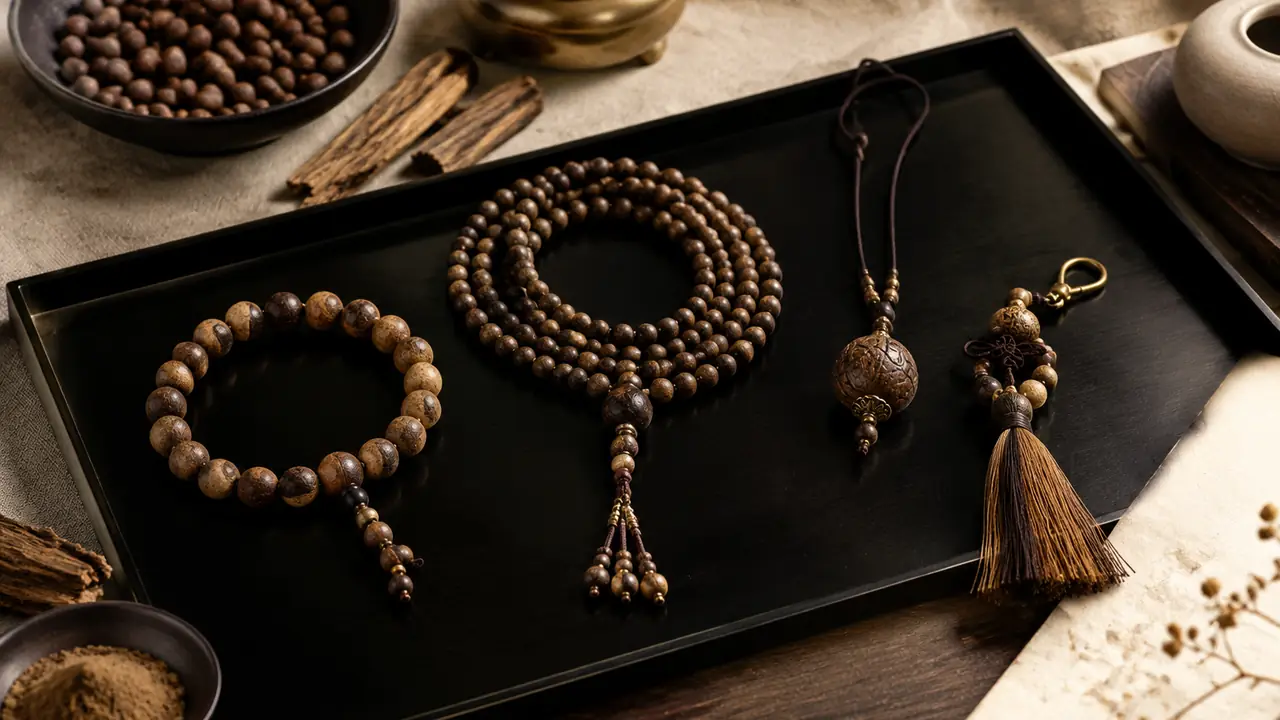
The structure of a 108 mala
A traditional mala has 108 beads plus one larger bead, often called the guru or mother bead, from which a tassel hangs. The strand is used by moving the beads through the fingers one at a time, which makes handling and friction a central part of the experience. For incense beads, that friction is useful: each pass of a bead releases a little scent. The reasons behind the number and the structure are explained in why 108 beads; this note stays with specifications.
The product is used across traditions and by people who use it with no tradition at all, so copy should stay neutral: describe it as a counting and focus tool, say what it is made of and let the customer bring their own meaning.
Choosing bead size
| Size | Strand feel | Typical use |
|---|---|---|
| 6 mm | Light, compact, wraps several times on the wrist | Wrist wrap, travel malas |
| 8 mm | Balanced, easy to handle for counting | The default for studios and retreat shops |
| 10 mm | Heavier, longer, bolder look | Neck wear, premium variants |
The usual choices are 6 or 8 mm. A 108-bead strand at 8 mm is a long loop, so a count of 108 plus a guru bead needs planning for length and weight. With a typical 8 mm bead weighing about 0.3-0.5 g, the beads alone are a modest weight, and the cord, guru bead and tassel add to it. Ask for the finished weight on the sample sheet. More on size effects is in incense bead sizes explained.
Cord and knotting: where malas fail
Most returns on malas come from the cord. A mala is handled more than a bracelet, pulled around the neck and wrapped on the wrist, so cord strength and knotting matter more.
- Cord material. Cotton, silk or waxed polyester cord are common. Elastic is unsuitable for a long strand because it fatigues.
- Knots between beads. A knot between each bead protects against loss if the cord breaks and keeps the beads from rubbing against each other. It adds labor but is worth it for a premium mala.
- Hole size. Holes commonly run 1.2-2.0 mm. The hole must pass the cord and the knot tail without splitting the bead.
- Closure. The guru bead end is typically tied with a double knot and hidden inside the guru bead.
Incense beads are slightly softer than hardwood beads, so knotting should be snug but not tight. Ask the workshop to show how knots are seated on a sample.
Guru bead, tassel and counters
Guru beads are usually a larger bead of the same formula, for example 10 or 12 mm in an 8 mm mala, or a contrasting material. Tassels come in cotton, silk or cord and can be dyed to match the studio brand. Optional counters, in the form of small markers placed at set intervals, make it easy to track a round. Metal spacers and a small silver charm can also be added, with holes matched to the spacers; see incense beads with silver. Each addition raises both the cost and the number of parts to check at inspection.
Scent choice for a meditation mala
Sandalwood is the usual scent for a mala because it is soft, warm and does not overwhelm a quiet room. Agarwood suits premium variants. Because a mala is handled often, the scent is strongest on the first few days and mellows as the beads are rolled between fingers. Many users describe the scent as calming, and it is reasonable to describe it as a sensory aid to a quiet moment; a mala should not be described as having any effect on health or mind beyond what the customer feels.
What studios and shops usually order
- A core 8 mm sandalwood mala with cotton tassel, in a cloth pouch.
- A 6 mm wrist-wrap version for customers who want something lighter.
- One premium variant, such as agarwood or a knot-between-beads finish.
- A DIY or loose-bead option for studios that run workshops; see loose incense beads.
Studio and retreat channels are discussed on yoga and meditation studios and temples and retreats. Pouch artwork, care card text and a small instruction leaflet are worth settling at the same time as the bead spec.
Quality checks specific to malas
Inspect a mala differently from a bracelet. Count the beads on a random sample from each lot: 108 plus the guru bead, with no missing or doubled beads. Check that the tassel is attached firmly and that knots sit snugly against the beads. Test the pull strength by hand on the cord, and check that the strand hangs evenly, which shows that holes are centered. Weigh a few finished malas and compare with the sample sheet. These checks sit within the inspection scope described in quality control.
Packaging and care for a mala
A mala should arrive sealed, because a long strand has a large surface and loses its surface scent quickly if left open. A small foil pouch with a desiccant, inside a cotton drawstring bag or a small box, is the usual solution. The care card should say to keep the mala dry, away from heat and sun, and to store it in its pouch when not in use. Because a mala is worn around the neck and handled with bare hands, skin oils and sweat will darken the beads over time; this is the patina that many owners like, and it is better explained on the card than left as a surprise. Do not suggest washing; wiping with a dry soft cloth is enough.
For shipping, pack malas flat or loosely coiled, never tightly bundled, so that knots and tassels are not crushed. Cartons that will cross humid routes should be lined, and the desiccant count raised for sea freight.
Minimums and timing
Stock malas are typically ordered at around 50-200 pieces per design, branded or boxed variants at about 300-1,000 per design, with sample times of 5-10 working days for stock items and production of 15-25 working days. These are typical reference ranges, confirmed in writing for each program, and a mala takes longer per piece than a bracelet because there are many more beads to roll and string. Send your brief through the quote form and see MOQ and lead time for the ranges.