
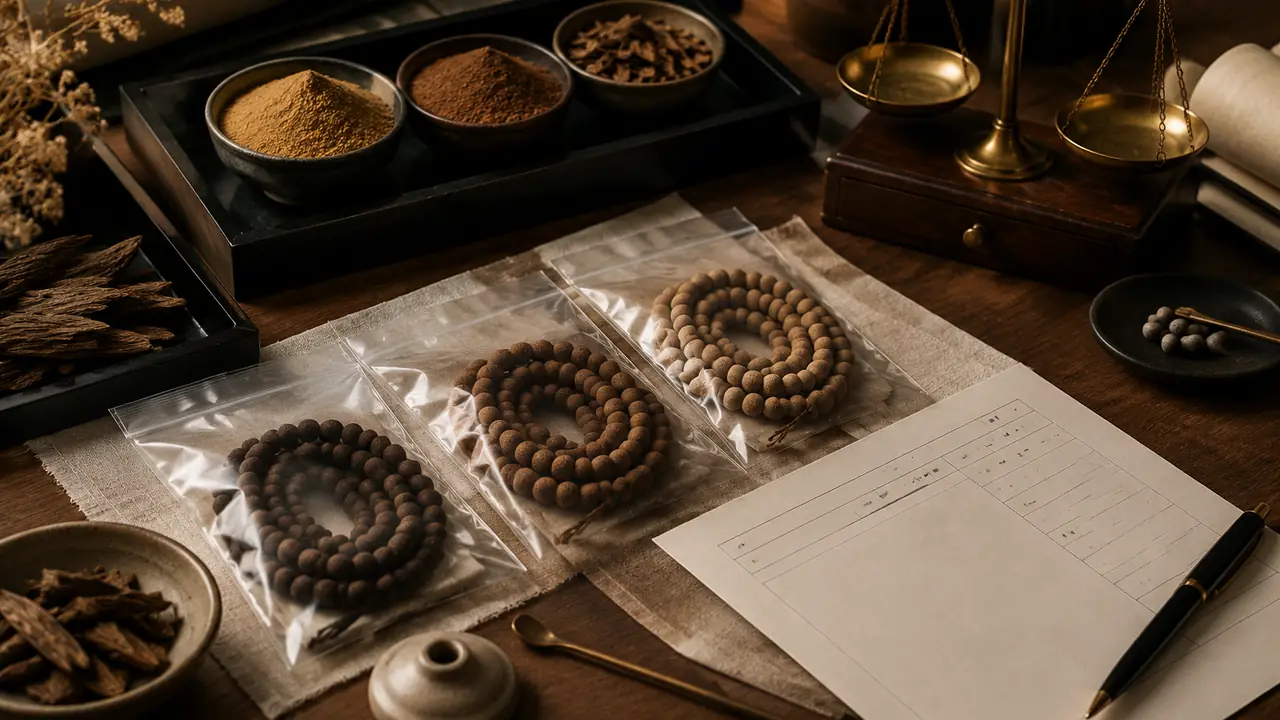
How the desk works
Ouvare is a sourcing desk. It does not own a workshop and does not claim to make the beads. It chooses partner workshops in the Fujian and Guangdong incense clusters, agrees a specification with them, checks the work and organises packing and freight. For the buyer, that means one contact, one written specification and one inspection record, even when several workshops and packaging suppliers are involved. The reasons that approach suits hand-made incense goods are explained on the industry clusters page.
The eight steps
- Brief. You describe the product line, bead size, quantity, target market, packaging and date. A short brief is enough; the desk asks for what is missing.
- Formula sheet. The desk writes the specification: ingredients by weight, bead diameter, hole size, count per strand, finish, cord and fittings, and the packaging format. You approve it before any sample is made.
- Samples. The partner workshop rolls, dries and finishes sample pieces. Stock samples take 5-10 working days; custom formulas 15-25 days, since drying and aging cannot be skipped.
- Retained sample. Once you approve the sample in writing, the desk keeps an identical piece as the reference for scent, color, surface and packaging.
- Batch. The workshop produces the batch against the formula sheet. Batch time is typically 25-40 days, with classical formulas longer.
- Inspection. Sampled pieces are checked against the specification and the retained sample, as set out in testing and inspection.
- Packing. Beads are sealed in pouches with desiccant, placed in the agreed packaging and cartoned and labelled. See packaging.
- Shipping. The desk books the route, prepares documents and sends tracking. Routes and papers are on logistics.
Who does what
| Step | You | Ouvare desk | Partner workshop |
|---|---|---|---|
| Brief | State needs, quantity, market | Ask questions, propose lines | Not involved |
| Formula sheet | Approve in writing | Write and confirm the specification | Confirm feasibility |
| Samples | Evaluate and approve | Coordinate and check before dispatch | Make and finish samples |
| Retained sample | Approve the reference | Keep and label it | Not involved |
| Batch | Hold specification changes | Track progress and report | Produce the batch |
| Inspection | Review the record | Inspect and write the record | Fix any rework |
| Packing and shipping | Confirm route and term, clear import | Pack, document, book and track | Release goods |
Communication rhythm
The desk writes whenever a step changes status: formula sheet issued, sample dispatched, batch started, inspection done, goods shipped. During production there is also a weekly note with the state of drying and any risk to the calendar, since weather can slow shade-drying. Messages come through email or WhatsApp, whichever you prefer, and every decision that affects the specification is also written down in the program thread. If a step slips, the desk reports it as soon as it is known and proposes a fix, not a surprise at the end. Questions are answered within the working day where possible, in your time zone as far as practical.
Where decisions need you
- Before the formula sheet is final. Material origin, agarwood share, bead size and finish are all hard to change later.
- At sample approval. Your approval in writing becomes the reference; changes afterwards reset the calendar.
- At packaging proofs. Print and label text should be checked by the person responsible for your market.
- Before shipping. You choose route, trade term and who clears import.
When something goes wrong
Hand-made goods vary, and sometimes a lot misses the specification: beads too small, cracks, an off scent. The inspection step exists to catch this before packing. Rework terms are agreed with the workshop before the batch starts, and the desk documents any issue with photographs and the measured values so that the discussion rests on evidence and not on impressions. A lot is released only when it matches the formula sheet and the retained sample, or when you accept a documented deviation in writing. If the fault lies in a change request after approval, the program is amended and reconfirmed. Details of the checks are on the quality control page, and workshop audit explains how partners are selected in the first place.
Starting a program
Send the brief with line, size, quantity and market. The desk replies with questions, a draft formula sheet and a written reference range for minimum and lead time, as summarised on MOQ and lead time. For a list of lines to choose from, see the product overview.